All the World’s a Stage for Hamnet’s Décor
An exclusive Q&A with production designer Fiona Crombie
Adapted from Maggie O’Farrell’s award-winning novel, Chloé Zhao’s Hamnet explores the odd mystery behind William Shakespeare naming one of his greatest plays after his own son. Following the lives of Will (Paul Mescal) and his wife, Agnes (Jessie Buckley), from their early romance to later tragedies, the film spins a remarkable tale about love, death, and the transformative power of art.
To help recreate the lived reality of Shakespeare’s world, Zhao tapped production designer Fiona Crombie, whose witty, elegant work for Yorgos Lanthimos’ The Favourite garnered her an Academy Award® nomination. The Rolling Tape writes, “You cannot help but sit in awe of the visual spectacle Crombie delivers on screen” by recreating Shakespeare’s home and his original Globe Theater.
We spoke with Crombie about the difficulty of recreating a Tudor home, the process of rebuilding the Globe Theater in nine weeks, and the cathartic power of drama.
The official trailer for Hamnet
How did you get involved working on Hamnet?
I got sent the script while I was working on a commercial in Brazil. I had just gotten ill, which in hindsight was a blessing, because it gave me time to devour the story. I reacted very strongly to the material. I put together a vast document of images that conveyed how I saw the film tonally. After a Zoom meeting with Chloé, I just clicked with her. When I got back to London, I went straight out to Stratford and got to work.
Were there existing tudor homes that you used as a model?
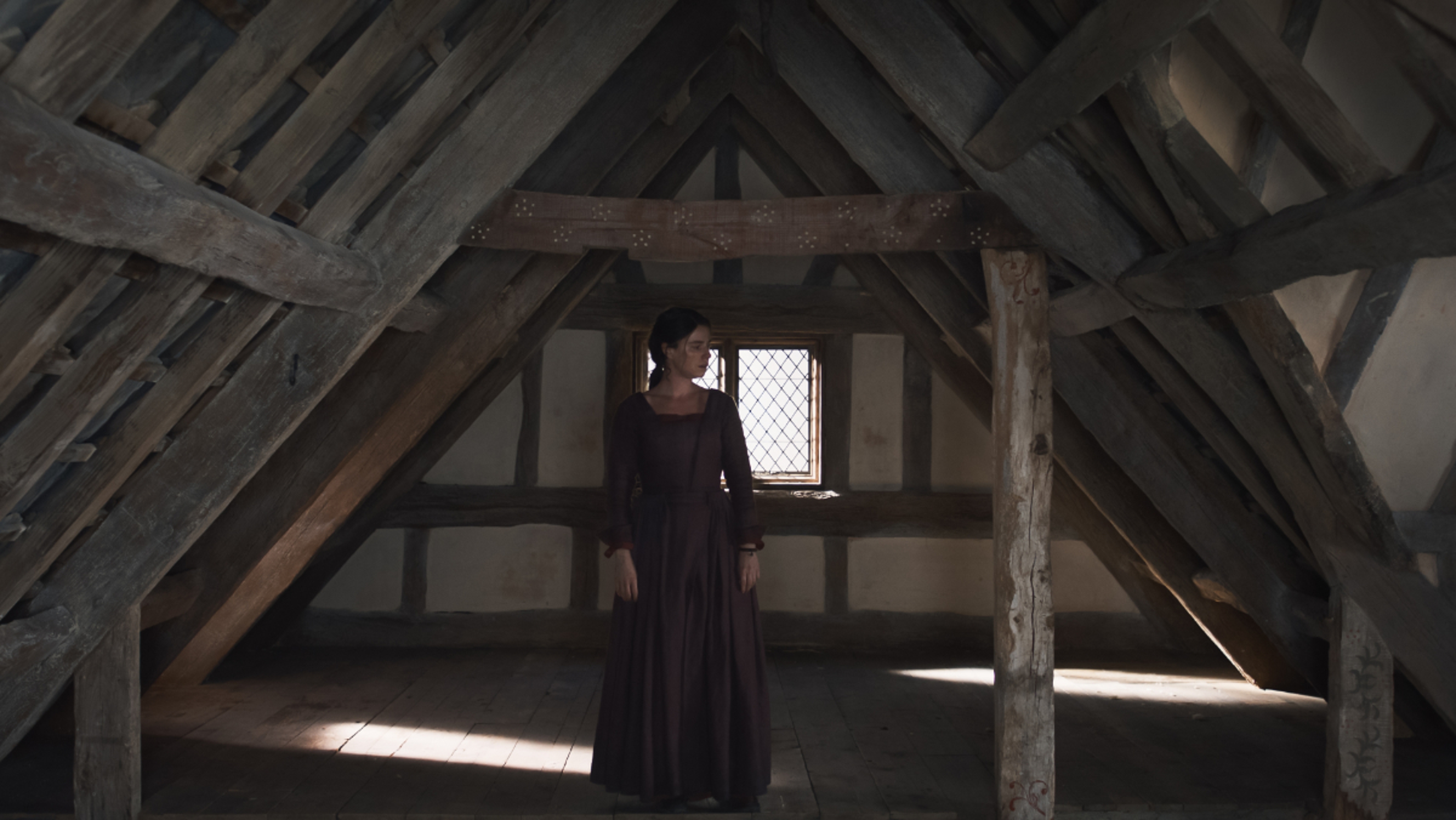
We scouted all over England and Wales looking for the right house. But they are almost impossible to shoot in. You can’t do very much because they are so precious. I snapped details of every little thing that I thought was interesting in those houses, which proved an incredible resource, since we were able to incorporate those details—all those little quirks and imperfections—into our set. It is those odd details that make the house feel grounded and real.
Initially the plan was to shoot on location, but it quickly became clear that wasn't going to work. We had to quickly design and build Shakespeare’s family house in nine weeks. My catalog of images became very useful, because I could say, “I love this window. I love the way the ceiling slants here.” We created this bespoke house that could frame our actors the way we wanted to frame them.
Creating the Globe Theater was a massive undertaking. Can you describe how you approached it?
Initially we used illustrations. But interestingly they were all of the exterior. I don't remember seeing any illustrations of the interior. The thing about the exterior illustrations is that they were a bit like real estate promotions where the Globe is really big and London is tiny in the background. It’s obvious they were suggesting, “Look how great our theater is.”
In many ways, it was very freeing knowing that the first Globe burnt down. The Globe that was rebuilt later was much more ornate, so the Globe we created could be a humbler theater where the focus is all on the stage. It wasn’t going to be about marble columns and gilt capitals. Our globe was about creating an environment where the plays could be performed.
Jessie Buckley in Hamnet
What did you see as your chief creative challenge?
Finding a way to honor the characters. I've made period films that look beautiful, but I wanted to cut through all that. Even though it’s set during the Elizabethan period with Tudor architecture, I wanted the audience to really connect with these people. I wanted to bring the audience as close to the family as possible through the design, giving them the sense that it was a real home and these are real people. I looked around my own home to see the basket of laundry that no one's touched for three days or the unmade beds. I wanted all that lived reality in this film.
So many of the natural locations are architectural. How did you scout and choose them?
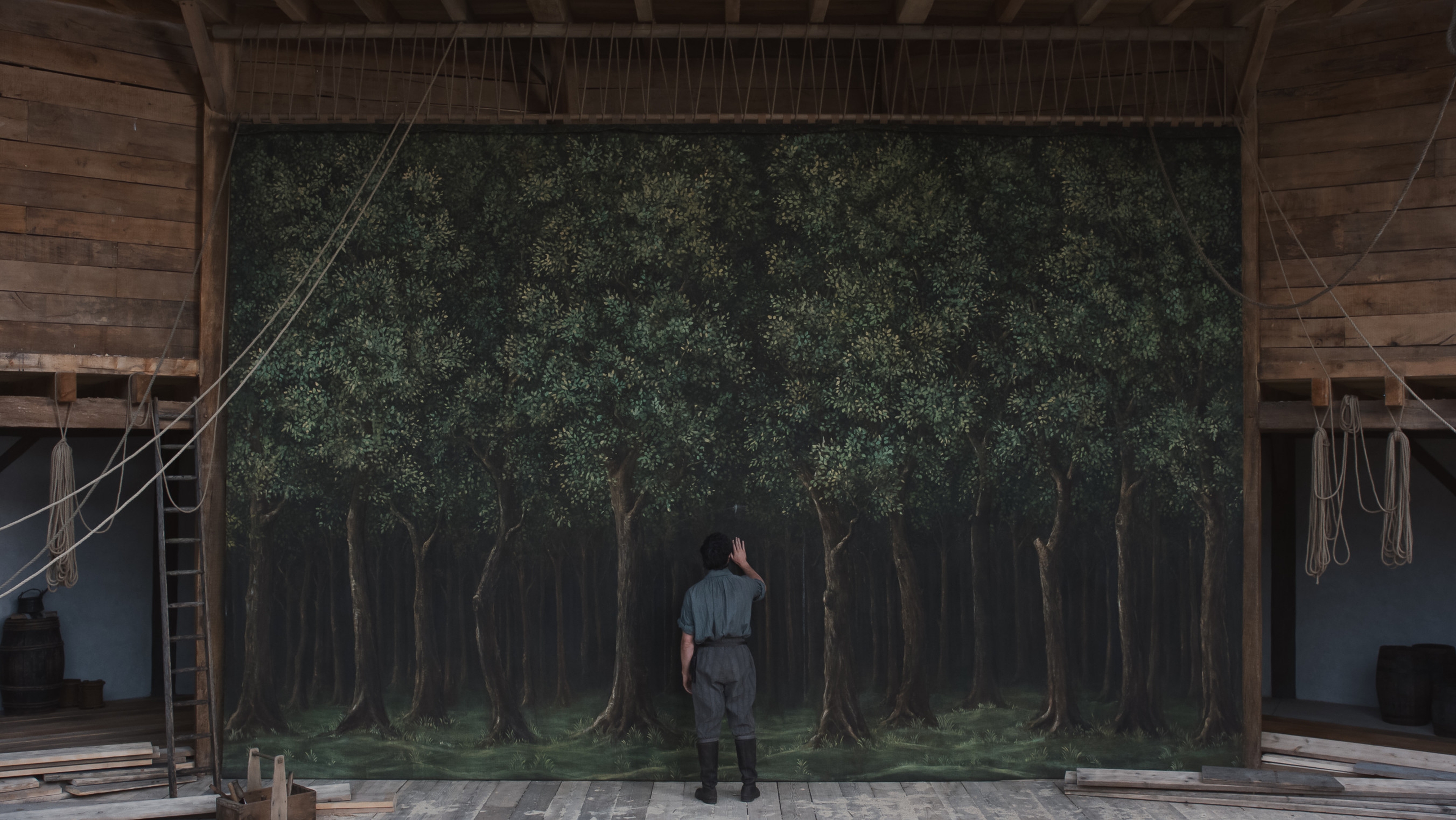
Chloé, Łukasz [Żal, the cinematographer], and I found the forest first. It was in that forest that we found the tree with a hole in it which becomes important to the story. We were really drawn to hollows and round shapes, these circular embracing shapes in the forest. The whole way through production, I kept thinking about this passage in the book where death is looking through a window from afar. The conceit of portals, especially in the house, became important to me. The openness of the forest provided a striking contrast with the architectural heaviness of the Tudor house, especially with the heaviness of the beams and the repetitive linear patterns, which all enhance that sense of containment—a feeling that is blown open when you go out into the forest.
How did you incorporate how Elizabethan people used their homes into the design?
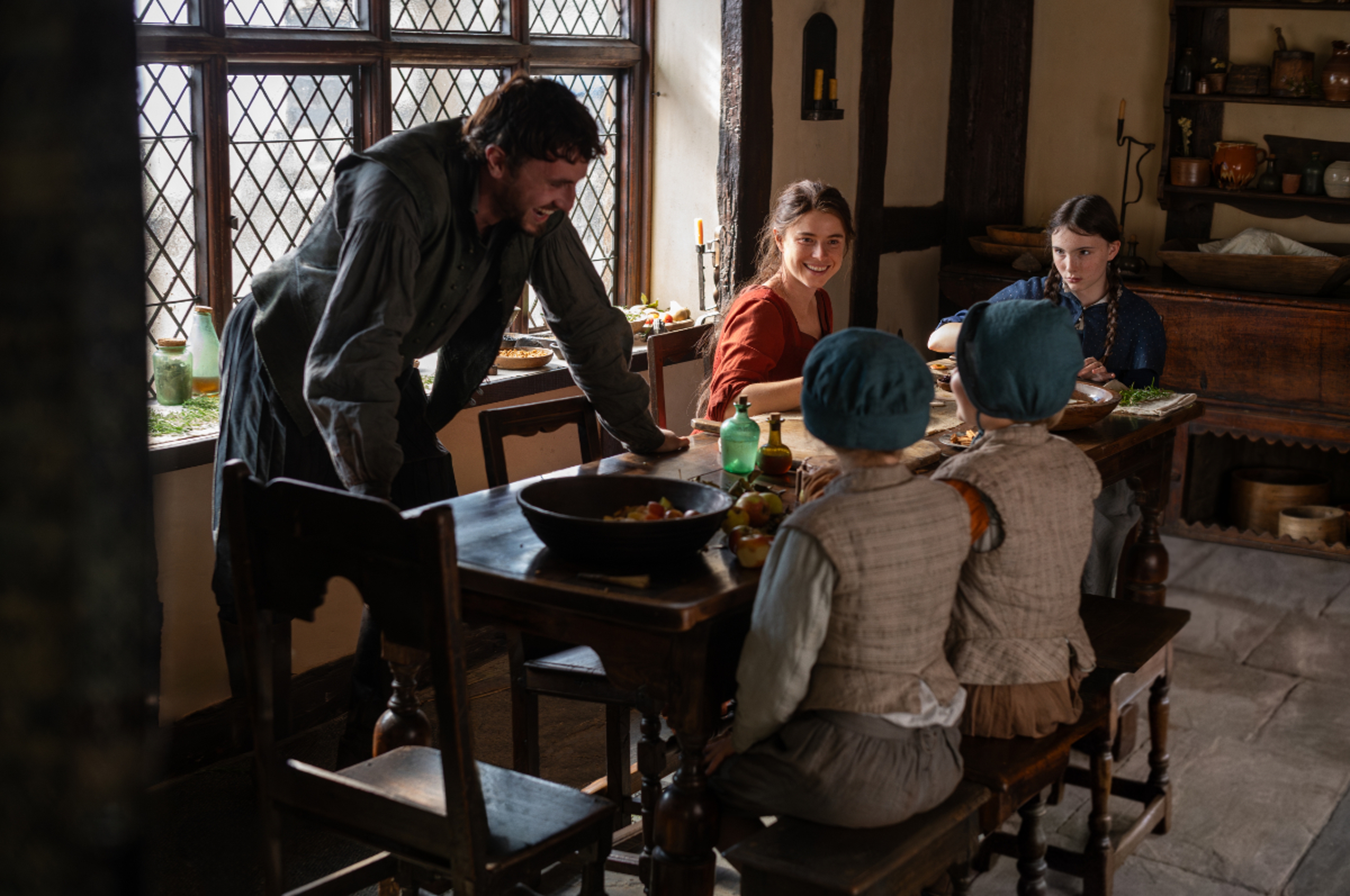
The key thing for the period is that there is constant industry in the home. In the book, Maggie O’Farrell beautifully describes the buzz of industry, all the everyday actions—the feeding of animals, the peeling of vegetables, the harvesting—that were necessary to run a family. The art department talked a lot about the ways we could bring that to life in the home. In the design, for example, you will see something drying on the windowsill or some activity on the table. We wanted to instill a feeling that there is always something that needed to be done.
Paul Mescal, Jessie Buckley, and Bodhi Rae Breathnach in Hamnet
You used reclaimed wood for the Globe?
We heard that the wood for the original Globe was secondhand, meaning it was either stolen or reclaimed. I love the idea that the materials had been scavenged before being put together, so that the wood itself had its own history.
How did you design the theater to enable shooting in it?
At the end of our forest week, we went to the existing Globe. Seeing the theater, Chloé said she felt it was too big. She wanted our Globe to be more intimate, so we shrunk the size down to about 70% of the original dimensions. After seeing the film, I can see how much that helped. When you're actually in there and you're looking at the camera, the actor’s relationship to the audience is so important. They had to be able to see the faces of the audience. Making contact with people in the audience was crucial to the theatrical experience. Chloé also wanted the theater to feel like the inside of a tree, which made me consider how we used all the timber and rustic joinery.
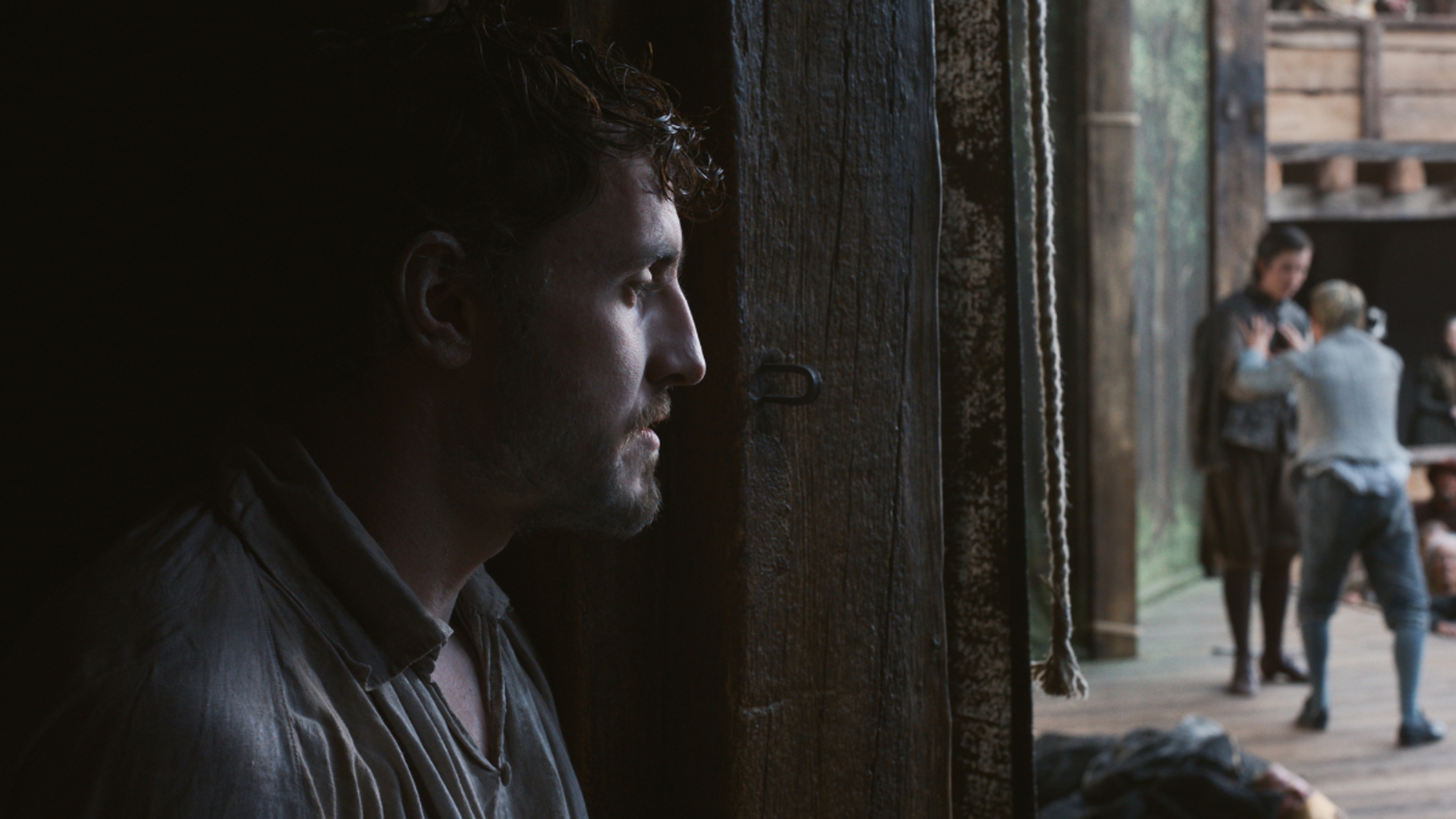
One of the changes we made to the original Globe design was the placement of Will watching Agnes. Traditionally, he would have been in a room called the Tiring House—which was where the actors got prepared—and therefore would have been much higher up than the audience. But we wanted him to see Agnes directly, so we cleared an area next to the stage for him. The other thing we added was the background scenery. There would not have been a painted backcloth. That area would have been open. But it was so important to have Will see Agnes through the scenery. There's evidence that painted backdrops may have been used in Italy at the time, so we just brought it to England a little bit earlier.
Paul Mescal in Hamnet
How did the globe work in terms of where the audience was and where the players enter and exit the stage?
For all practical purposes, we created an operating theater. We set up the backstage. During production, my standby team was dressed in period costumes. In the back, we set up where the hand props were. We had a make-up station. We made the theater operational so that the whole play could run seamlessly and the actors knew exactly where to go on and exit. We weren’t stopping all the time to change the set, especially when we were shooting long sections of the play.
Can you describe what theater meant to people during this time?
The audience for the most part was illiterate. For them, this was one of the only versions of storytelling around since very few people read anything. Going to the theatre was an incredible escape and remarkably accessible to the public. Since it was a repertory theater, which might show a comedy one day and tragedy the next, people showed up not really knowing what they were going to see. As simple as that stage was, the theatrical spectacle of seeing people performing would have been amazing to the audience.
What do you hope to take away from the film?
The thing that I have found incredibly important about the film is the way we have the ability to process our experience through art. When I saw the film with an audience, I remember realizing how the film mirrored this audience with the audience in the Globe. All the emotions that Agnes was experiencing watching the play were like what we were experiencing watching the movie. That is what art can give us.
This interview has been edited and condensed for clarity.

Bring the World of Hamnet Home
Featuring apparel, stationery, and collaboration pieces shaped by the film’s organic elements, floral artistry, and its powerful story of love and loss. Each piece captures a touch of Agnes and William’s world, bringing the film’s quiet beauty to life.
