Making the Strange Real in Bugonia’s Spaces
An exclusive Q&A with production designer James Price
In Yorgos Lanthimos’ Bugonia, Emma Stone plays Michelle Fuller, the CEO of a major pharmaceutical company, who is kidnapped by conspiracy-obsessed Teddy (Jesse Plemons) and his cousin Don (Aidan Delbis) who believe she is an alien intent on destroying planet Earth. Their wildly divergent worldviews are captured beautifully in the designs of their different spaces.
James Price, who won an Academy Award® in Production Design for Lanthimos’ Poor Things, created the contrasting visions in the film. Screen Daily writes, “the messy isolation of Teddy and Don’s home…is a stark contrast with the faceless, futuristic monolith of the Auxolith headquarters and the gleaming modernity of Michelle’s palatial pad.” In crafting these strange, sometimes surreal worlds with sharp authenticity, Price provides a keen insight into the world we live in now.
We spoke to Price about his complex process in bringing Lanthimos’ vision to fruition.
The official trailer for Bugonia
This is your second film with Yorgos Lanthimos. What did he tell you about it when you started out?
In classic Yorgos style, there was a short email that said something like, “Going to send you a script. Might be my next movie. Let me know what you think. See you soon.” After I read the script, I emailed back, “I love this script. It is so funny.” It was like reading Fargo meets The Big Lebowski. And then I got to the end and I was, “Oh my God!”
What were your initial thoughts about the design?
I thought Teddy’s home was going to be crucial. You live or die by that house and what’s going on there. We wanted to tailor every detail to fit how it would be used and shot. We wanted to give Yorgos the freedom to put the camera wherever he liked and for the cast to move anywhere they needed to move. We wanted to create a space they could simply exist in—so the story could happen naturally. The experience becomes completely immersive.
First, we decided to build just the house and deal with the basement differently, and we started looking for places around London, since so many of the collaborators are based there. While we were scouting, Yorgos asked me, “Why don’t we build the basement with the house? Think of the benefit for the film.” Initially, I thought of the various technical issues—we could hit bedrock, or we might be on something fluid. But we tested our location with pilot holes, and it all worked out.

Jesse Plemons and Emma Stone on the set of Bugonia
There is a stark difference between Teddy’s home and Michelle’s world. Can you talk about how you created Michelle’s office?
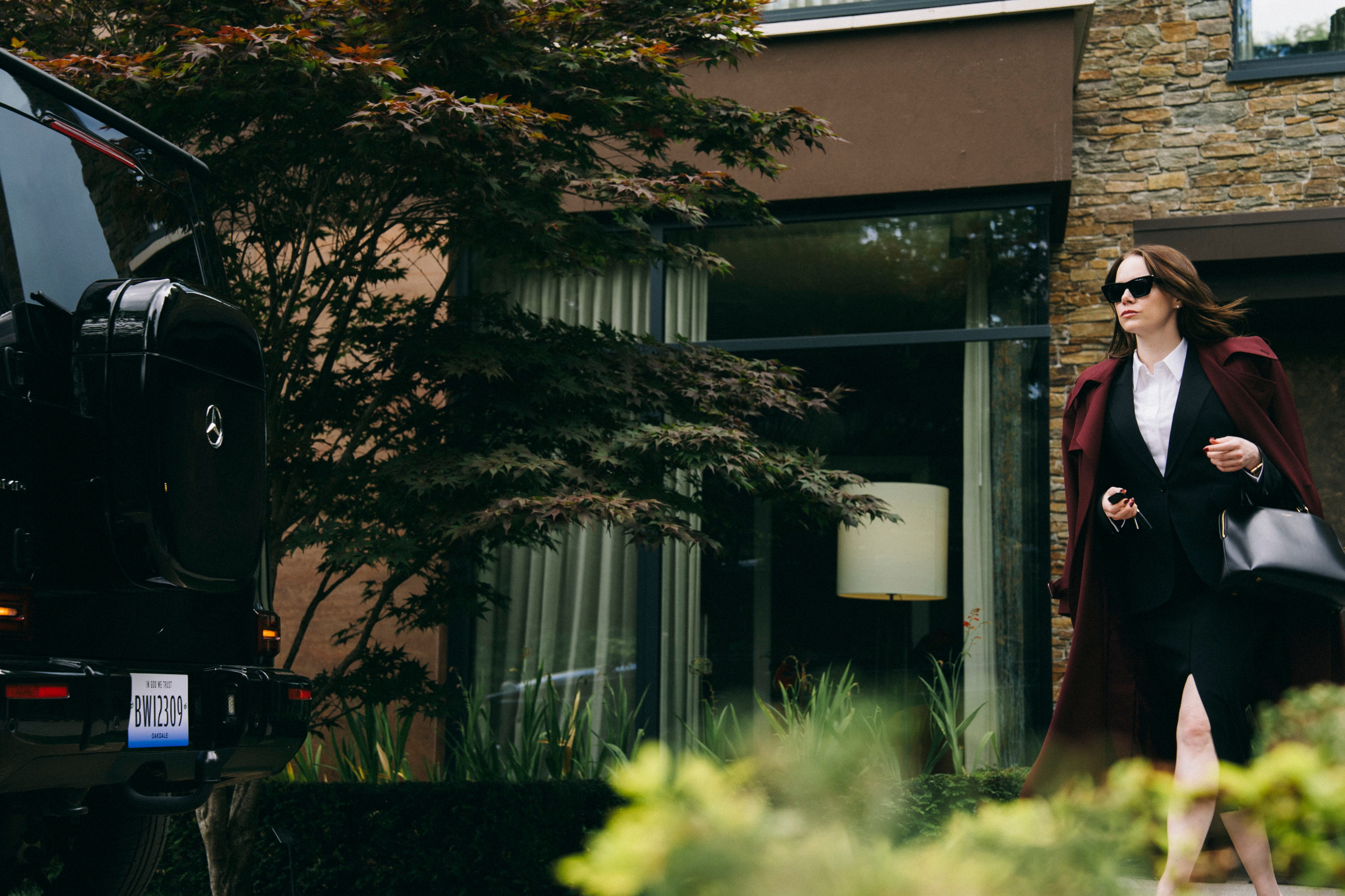
Initially, I thought of a big pharmaceutical company, but then we found an office space outside London with large glass expanses that we could tailor to fit her look. It had a bare floor and no suspended ceiling. We put in a long, dark carpet that leads past all her minions to her office. I wanted it to have the feel of a modern spaceship that hugs the landscape. The singularity of the building’s design is juxtaposed with the chaos in Teddy’s mind—a million and one things going on—while Michelle is just focused on one goal: increasing the stock price for the shareholders.
Can you talk about the design of her home, which you furnished with such high-end items like Henrik Pedersen’s Imola chair and Jan Bočan armchairs?
It was a matter of taste. Whether she understands the design, she knows that those pieces cost a lot of money. Fittingly, the house we used was built by the CEO of a FTSE 100 corporation. It perfectly reflected that particular mix of wealth and taste.
How closely did you work with costume designer Jennifer Johnson to refine Michelle’s and Teddy’s styles?
Massively. JJ and I work pretty closely together since one’s work informs the other. We talked about colors a lot. The beautiful trench coat that Michelle wears, along with her designer shoes, became a sort of uniform and set a particular look for the film’s design.
How did you coordinate your design with the director of photographer Robbie Ryan’s preference for wide shots.
Simple. I just plan for all the shots to be super wide. But it is great. In most films, 90% of what we do in production design doesn’t get seen. But with Yorgos and Robbie, about 90% shows up. I really love that and it drives me to build immersive and full sets. His work feeds naturally into the way I think about design and lighting.
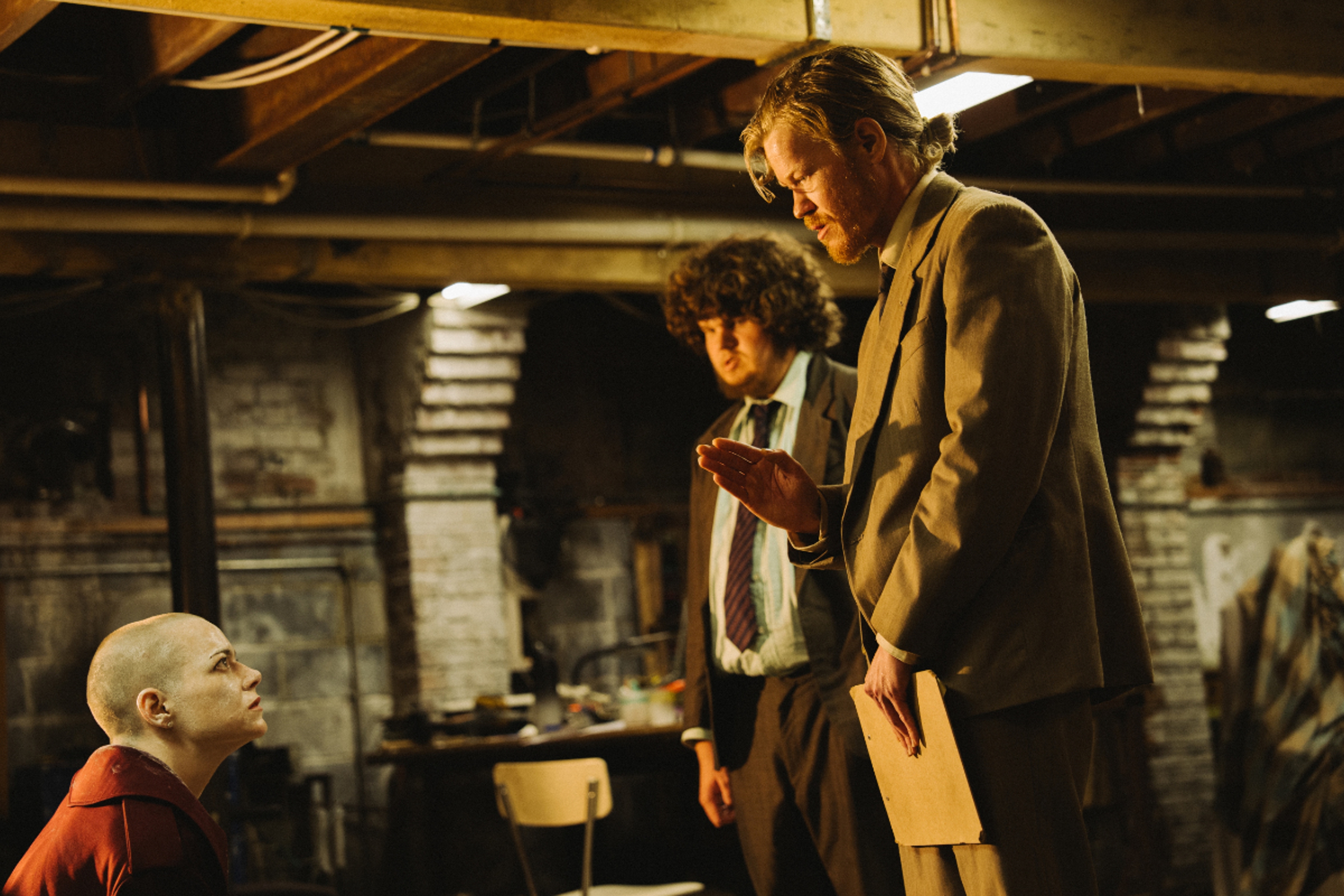
In creating the basement, you have natural light coming from high up with the windows. Then we have architectural lighting, which are strip lights to give a harder light. And then there is the practical lighting of the desk, table, and floor lamps. For me, production design and cinematography are one and the same thing because I want to create sets that work with the lighting. Robbie is a master at lighting naturalistically so you see everything and the camera moves in such a peaceful way through the space.
Emma Stone, Aidan Delbis, and Jesse Plemons in Bugonia
In Teddy’s basement, your design worked with the layers of darkness that exist there.
Our gaffer, Johnny Franklin, did a really great job figuring out how to light the basement to show off the different spaces. The stairs, for example, are in the middle of the space, so we want things behind them to fall off into shadow. When you look at that basement with the details that the set decoration, art direction, and scenic work layer on, it’s quite incredible. I remember seeing the film the other day and thinking to myself, “Is that a set?” even though I knew it was a set.
What was your inspiration for Teddy’s space?
I don't tend to use many film or photographic references because it can become somewhat self-referencing. I try to push and find real world references. I considered a lot of the homes—like ranch houses—that I looked at for the film The Iron Claw. There is an incredible book called Armed America: Portraits of Gun Owners in Their Homes which is a collection of portraits of people in domestic scenes with their guns laid out. It provided a wider view of their living rooms or home offices. We were trying to go beyond the usual suspects of influences like Gregory Crewdson’s photography, although his stuff is beautifully art directed. To get a more natural look, we needed to dig a little deeper. The set decorator spent a lot of time going through real estate websites looking at kitchens and other rooms that felt authentic.
I remember a house I visited in New Zealand that was owned by three brothers whose parents had died. They lived on their own but weren’t quite up for looking after themselves. The original house was beautiful—probably from 1880—a stunning piece of architecture. The brothers had been living there for half their lives on their own, and the place was beyond squalor. Places like that fed into my inspiration for Teddy’s home.
What do you hope audiences take away from the film?
Question everything—especially yourselves. We are living in dark times, so maybe let’s not be so polarized.
This interview has been edited and condensed for clarity.
