Hot Spot’s Cinematography Makes Visual the Visceral Reality of its Fantastic World
An exclusive Q&A with director of photography Jakub Kijowski
Agnieszka Smoczyńska’s Hot Spot presents a dystopian vision of the future in which an arid, hot world tottering on the edge of collapse is ruled by a sentient AI. Nevertheless, Djonny (Andrzej Konopka), a private eye, who lives with his wife, Ayka (Reika Kirishima), and their son, Zen (George Aurimas Cris), struggles to uphold the rule of law by investigating the murder of a refugee. While struggling to maintain a human perspective, his sense of the world detours into dangerous territory after meeting Rana (Noomi Rapace), the mysterious rebel leader.
To make this strange new world real, Smoczyńska teamed up with her long-time collaborator, director of photography Jakub Kijowski. As with their earlier film, The Silent Twins, about which Awards Watch wrote, “Smoczyńska brings life to the darkest aspects of the story with the help of her regular cinematographer Jakub Kijowski,” the filmmakers translated the visceral experience of a dusty, hot world into a new visual language.
We spoke with Kijowski about his cinematic references, the film’s unique locations, and how the story reflects our current experiences.
The official trailer for Hot Spot
What did you think when you first read the screenplay for Hot Spot?
I’ve been working with Agnieszka for a long time. I thought this would be another adventure. I wasn’t wrong.
What were your first thoughts about how to shoot this?
To be honest, I was a little terrified at first. I realized just how demanding it would be to create a complete vision of a future world. I started thinking about what I knew about this world we were supposed to create, and what personal experiences I could draw on. Reading about this world’s prevailing drought and heat, we know the future won’t get any cooler. So, from the very beginning, I thought about the sun, harsh light, and deep contrasts, which should form the film’s visual language.
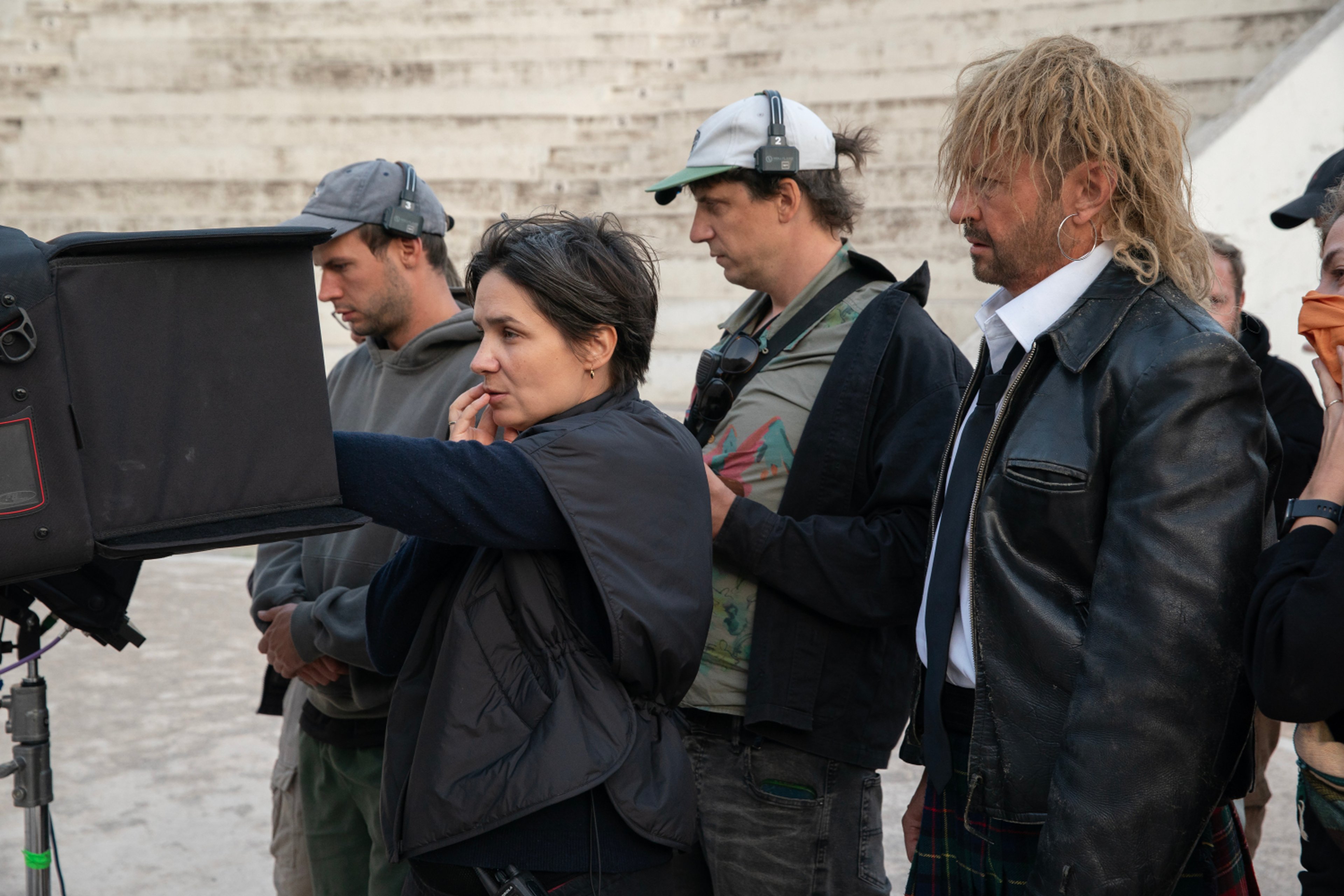
Director Agnieszka Smoczyńska, cinematographer Jakub Kijowski, and Andrzej Konopka on the set of Hot Spot
What sort of references did you draw from cinema history?
Thinking about inspirations drawn from other films in the case of Hot Spot was a very ambivalent experience for us. From the very beginning, we wanted to create an original vision of the world. Of course, there were plenty of dystopian films. However, we wanted to ensure that the viewer didn’t get the impression that we were winking at them and saying, “You know how this works… you’ve seen this somewhere else.” We were more interested in surprising the audience.
The film flirts with familiar conventions from cinema. In terms of cinematic language, we consciously blend conventions by referencing well-worn cinematic images. For example, when Djonny gets out of the car, we first see his shoes. This shot is like a reference to Sergio Leone’s Once Upon a Time in the West. At that moment, Djonny feels like a sheriff, but later an almost musical sequence unfolds, and, in the very next scene, we find ourselves in a brutal and realistic scene on a train, where Djonny hides from danger, much like in Alfonso Cuarón’s Children of Men.
The cinematography uses the barren landscape to such great effect. How did you approach locations?
I think two decisions were truly crucial to the film’s form. The first was the decision to shoot in Greece, near Athens. These places not only suited the film but also became a great source of inspiration for us. For me, as a cinematographer, location scouting is a very important part of the preparation process. We visit many places, and then we return to them to take additional photos and analyze the sunlight. Agnieszka and I joke that for a cinematographer choosing locations is almost like casting the lead actor for a director.
We want the locations to complement the scenes and create a mood that resonates emotionally with the audience. In Hot Spot, we had wonderful producers who found the abandoned Ellinikon International Airport in Athens—a monument to 1960s architecture. Just entering the empty halls of the passenger terminal was incredibly impressive. The scale was overwhelming; everything was covered in dust. The sun streamed in through the enormous windows.
We worked at the airport for many days. Outside the buildings, the airport’s massive concrete slab heated up to unimaginable temperatures; inside, it was possible to find some shelter from the sun. We realized then that in the world we wanted to portray, being out in the sun could be a form of oppression—that in the camp, the refugees would be outside, while the guards watching over them would be inside. This camp is thus like an inverted fortress, where the guards are inside and the prisoners are kept outside.
Another important location was our visit to the fire-scarred hills of Marathon. It made a profound impression on me. When we were on those fire-scarred hills, it became clear that this place deserved its own section in the film. The tree trunks against the backdrop of the dry earth were so black that they were sometimes difficult to photograph. Once again, they evoked images from Westerns, where the heroes ride into a “death zone” in a landscape over which vultures circle.
Our other key decision was to shift the world’s aesthetic toward retrofuturism. Largely inspired by the locations, we began to think that we wanted our world to look not like a futuristic dream, but rather like a vision of the bankrupt world we know. This was a pivotal decision during the course of the project. Inspired by this idea, I proposed a somewhat old-fashioned storytelling style, based on simple camera movement and the contrast between close-ups and wide shots.
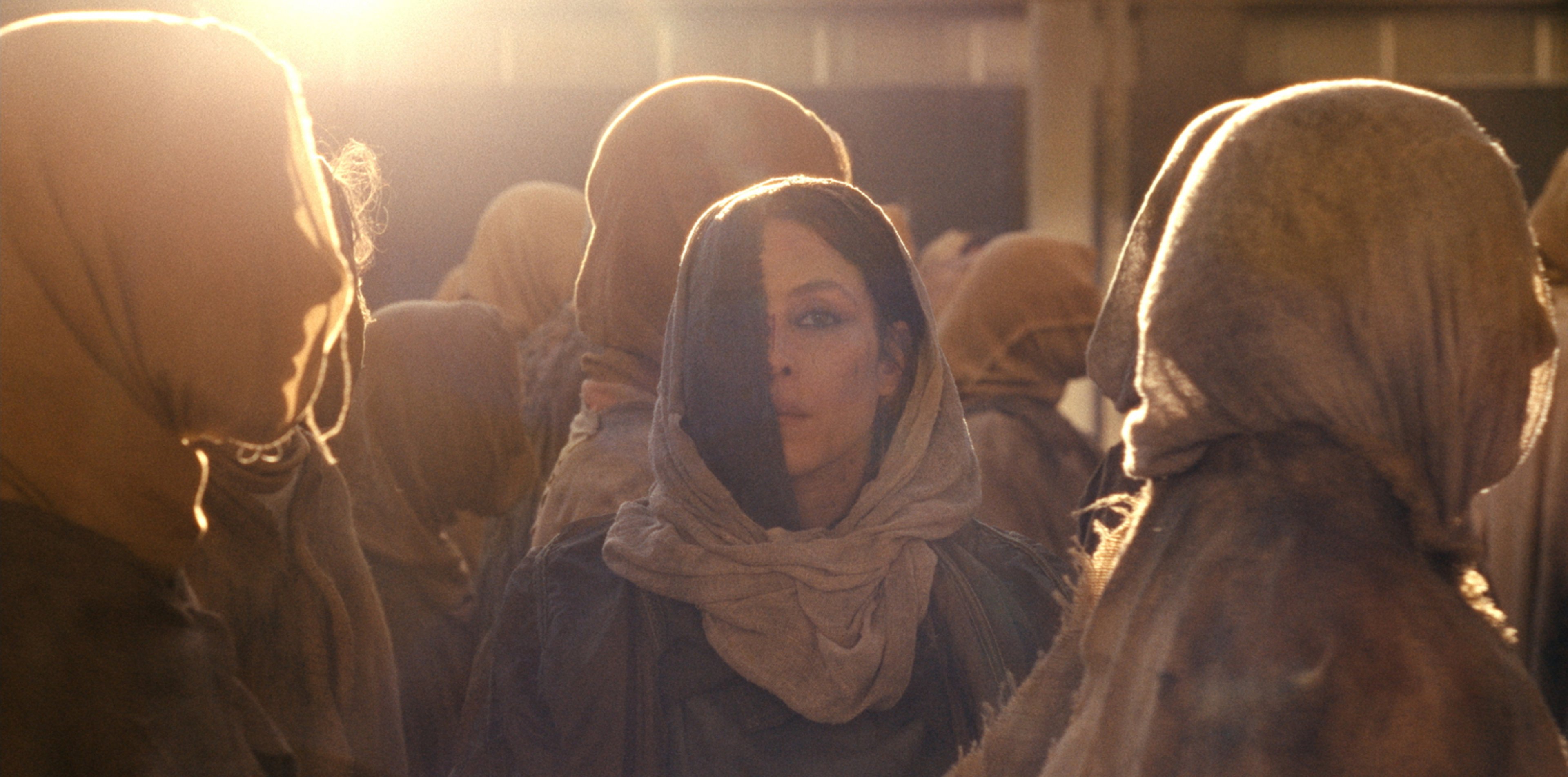
Noomi Rapace in Hot Spot
As a cinematographer, how do you capture the sense of heat and aridness visually?
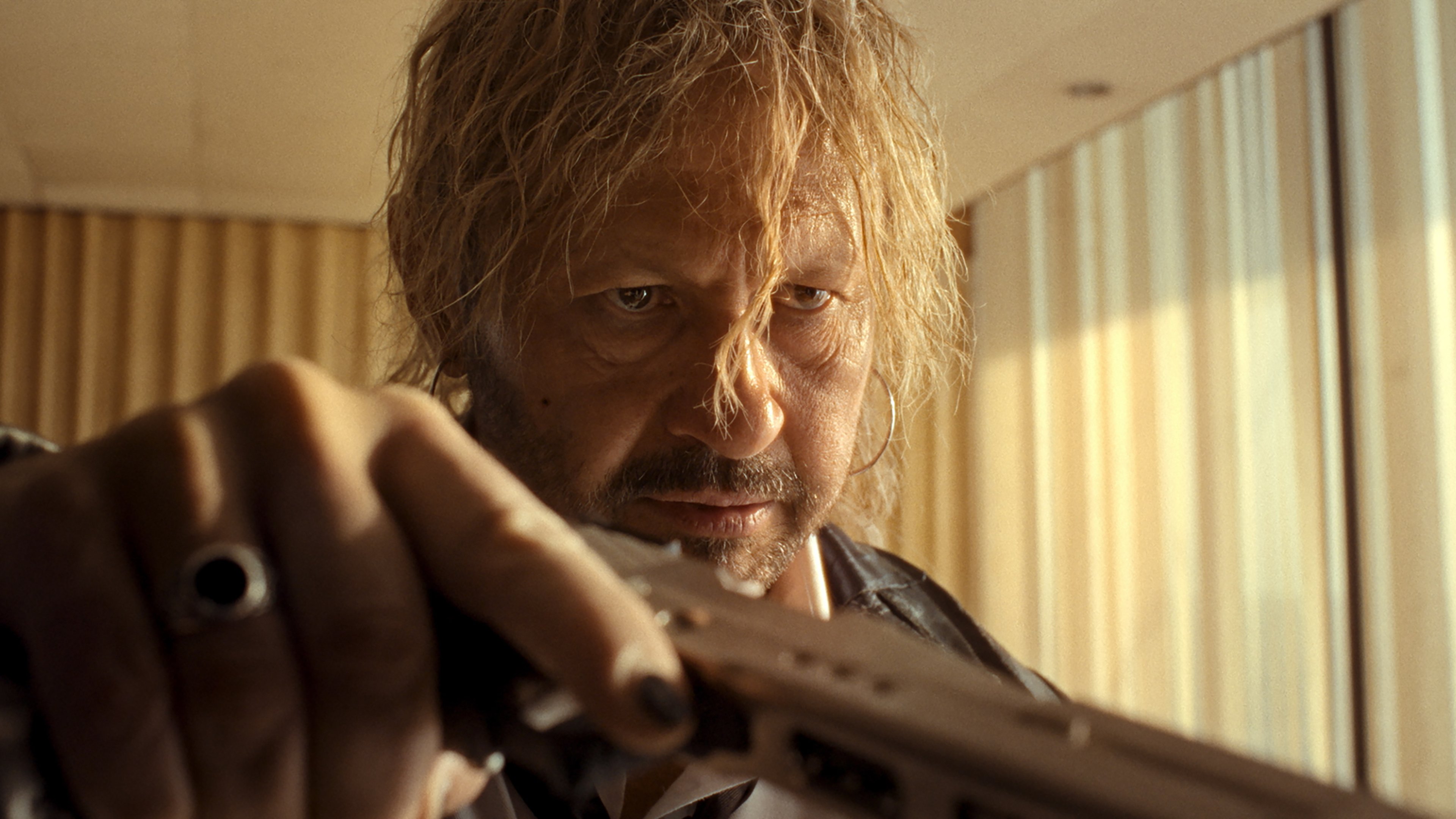
I really wanted to capture the heat, the sun, and everything associated with it. We used sharp diagonal shadows on the walls, sharp boundaries between shadow and light, the glaring light of bright buildings. I wanted the sun to always be visible on our characters, so their faces would glisten. I wanted to emphasize that there’s no escape from the sun. While working on the film’s final color grading, my guiding principle was that the film should look as if it were dry and scorched by the sun. In post-production, we removed all the green plants that we hadn’t managed to keep out of the frame.
Can you talk about the way the film at moments could be fantasy or could be real?
I was deeply inspired by a certain reflection on the present day. Namely, people addicted to social media stop perceiving reality directly. They begin to perceive the world as a reflection filtered through technology. It’s hard to judge what is a real emotional experience for them, what is actually being present in a situation, and what is simply the story they post about it. These people see reality in a processed form. I think that for them, the real world can even be surprising. We decided that in scenes where the characters are disconnected from the system, there’s an opportunity to depict reality in a hyper-realistic way. Color became the main means of expression.
What do you hope audiences take away from the film?
For me, the most important theme is the climate catastrophe and the related threats posed by the development of artificial intelligence. The environmental and social costs of the rapid development of AI models could be catastrophic. Water and energy resources are limited, yet AI models appear to the average user as cheap and free tools. I fear, however, that humanity will pay a price. It’s better for us to be aware of this in advance.
This interview has been edited and condensed for clarity.
